
Google Ads for Med Spas
Should Med Spa Ads Use a Booking Page or a Landing Page?
The best page after a med spa ad depends on what the visitor needs before making an appointment.
Someone searching for a familiar repeat treatment may be comfortable choosing a time. Someone comparing a new or higher-consideration treatment may need answers before booking.
This guide helps med spa owners choose among direct booking, a treatment landing page, a consultation form, and a form followed by a calendar.
Start With a Treatment-Specific Page
Do not send every ad to your homepage or one general booking page.
Create a focused page for the treatment in the ad. A Botox ad should lead to a Botox page. A facial ad should lead to a facial page.
Google recommends that the landing page closely match the ad, keywords, and promised action. The page should also make the next step clear and work well on mobile devices. A specific call to action can help filter out people who are unlikely to become customers. Google provides these landing page recommendations in its Google Ads guidance.
A treatment-specific page also gives you room to answer the visitor’s main questions:
- What is the treatment?
- Who is it for?
- What does it cost?
- How long does it take?
- Who performs it?
- Is a consultation required?
- What should the visitor do next?
After answering those questions, you can send the visitor to the right action: direct treatment booking, consultation booking, or a short form followed by a calendar.
When Direct Online Booking Makes Sense
Direct booking is often a good starting point for a clear, standard service.
Think about a defined facial offer. The visitor can see the price, appointment length, provider, and basic preparation details. There are not many choices to make before booking.
A discussion among med spa professionals described direct booking as effective for a clearly priced facial and B12 promotion. The offers were easy to understand before the visitor reached the calendar. This is an example from industry participants, not a result every med spa should expect. Read the MedSpa discussion about direct booking and consultation offers.
Direct booking may fit services such as:
- A named facial with a clear price
- A simple skin service
- A standard follow-up appointment
- A defined promotion with few choices
- Another lower-commitment service patients already understand
Routine services such as Botox or HydraFacial may require less comparison than full filler plans, laser resurfacing, or body contouring. However, the first appointment may still include a health-history review, treatment-area assessment, discussion of goals, and a personal recommendation. The provider may perform the treatment that day or schedule it for later. This medically reviewed appointment guide describes what patients may experience at a first med spa visit.
Direct booking does not remove the need for medical screening, informed consent, or provider judgment. Your state’s laws and professional rules still apply.
When a Consultation Is the Better First Step
A consultation is usually safer when the correct service cannot be chosen from a short menu.
A visitor may know the result they want without knowing which treatment is appropriate. For example, someone may want a more defined jawline but may not know whether fillers or another option fit their needs.
A consultation path may make more sense for:
- A full filler plan
- Body contouring
- Laser resurfacing
- A treatment that requires medical screening
- A service with several possible treatment areas
- A plan that depends on the patient’s goals or health history
- A high-commitment treatment that requires more trust
One med spa advertising guide describes dermal fillers and body contouring as longer-decision services that depend heavily on consultation and follow-up. The same guide presents facials and skin services as simpler entry treatments that may fit a direct offer. Review the guide’s treatment-by-treatment advertising recommendations.
A consultation does not have to mean, “Complete this form and wait for us to call.”
You can let the visitor book a consultation directly. This keeps the necessary evaluation step while allowing an interested person to reserve a time immediately.
Consider a Form-and-Calendar Option
Some treatments sit in the middle. The visitor may want guidance but may not be ready to choose a time.
A useful option is:
- Ask for a few basic contact details.
- Confirm that the med spa received the request.
- Offer an appointment calendar immediately.
- Provide a phone option for anyone who needs help.
This path captures the inquiry even if the visitor leaves before choosing a time. It also lets a ready visitor finish booking without waiting for your staff.
Keep the form short. Do not ask for medical details unless they are truly necessary and your systems are set up to handle them properly.
Appointment pages and forms can collect identifiable health information. This may include contact details, appointment dates, and reasons for seeking care. HIPAA-regulated businesses must prevent tracking tools from improperly sharing protected health information. In some cases, a tracking vendor may need a business associate agreement. The U.S. Department of Health and Human Services explains these online tracking concerns.
HIPAA rules depend on your business and the information being collected. Covered med spas should have qualified privacy counsel review forms, booking tools, advertising tags, and vendor agreements.
Remove Friction From the Booking Process
A direct calendar will not help if it is hard to use.
Make the booking button easy to find. Keep the visitor on a clear path. Do not force someone to create an account or move through unrelated pages before choosing an appointment. A spa advertising presentation recommends pairing one service and one offer with a page that repeats the offer and makes booking easy. Watch the presentation about Google Ads for salons and spas.
Your page should also show enough trust information to support the decision. That may include provider credentials, clear treatment details, and real patient photos used with consent.
In one Google Ads discussion, commenters suggested using one procedure per page, placing the action near the top, and showing credentials and real patient images. One commenter also said aesthetic clinics received more calls than forms in their experience. These are useful observations, but they are not universal performance standards. See the discussion about med spa campaign conversions.
Keep a phone option available. Patients have different scheduling preferences and accessibility needs. Research involving 1,000 U.S. consumers who had searched for a healthcare provider found that people valued convenient access, accurate information, and digital self-service. The report also supports offering more than one way to access care. Read the 2022 Patient Access Journey Report.
Do Not Judge the Page by Form Counts Alone
A cheap form submission is not always a good result.
Track each stage separately:
- Form submissions
- Phone calls
- Booking starts
- Completed bookings
- Attended appointments
- Paid treatments
A booking button click only tells you that someone started the process. It does not prove that the person booked, arrived, or paid.
A dermatology advertising presentation recommends tracking calls, lead forms, and completed appointments separately. When the booking platform supports it, a completed appointment can be reported back to Google Ads as the main result. Booking starts and calendar clicks should remain separate because they do not confirm an appointment. Watch the dermatology tracking presentation.
Your staff process matters too. A form-based path depends on quick, organized follow-up. Every delayed response or missed after-hours request adds another chance for the visitor to disappear.
Direct booking removes some of that delay. It can still fail if the calendar presents too many choices, asks for too much information, or does not match the advertised offer.
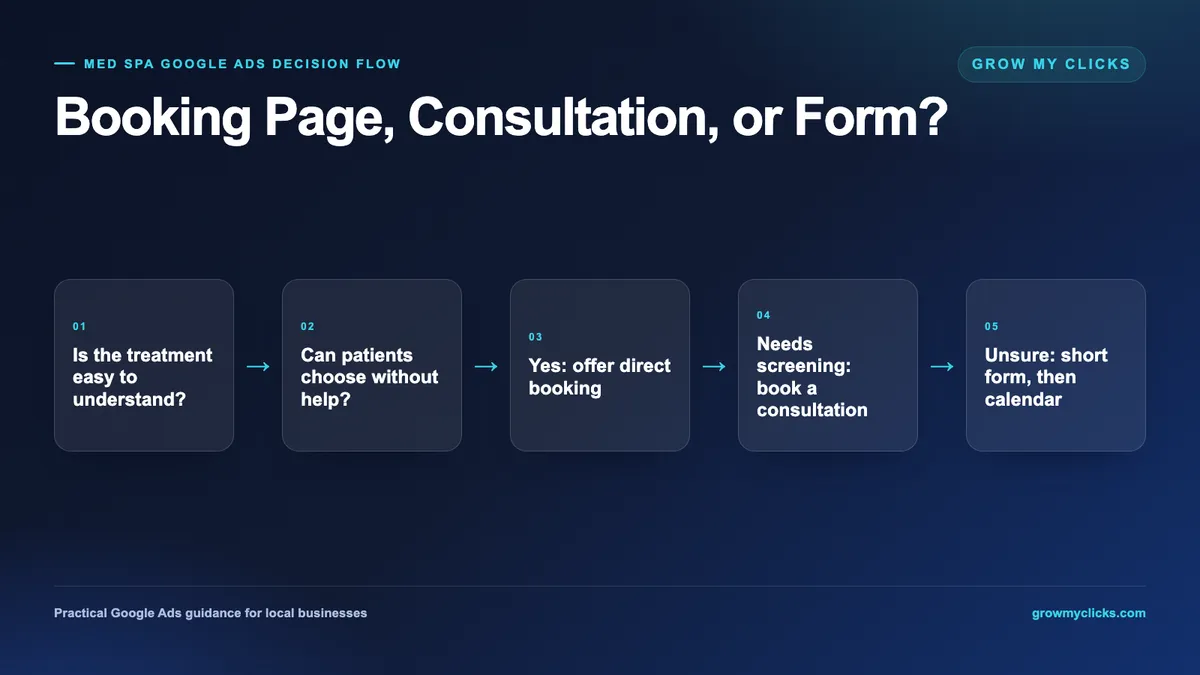
Use This Five-Question Test
Before choosing the path for a treatment, ask:
- Is the service standard and easy to understand?
- Can the visitor understand the price before booking?
- Is medical screening or a personal plan required?
- Can the visitor choose the correct appointment without help?
- Can your staff respond quickly when someone submits a form?
If the first four answers support a simple choice, test direct booking.
If the treatment requires screening or a personal recommendation, lead with a consultation.
If the visitor may need help but could still be ready to schedule, use a short form followed by an optional consultation calendar.
Test one path for each treatment. Watch completed and attended appointments for several weeks. Change one major page element at a time so you can see what helped.
The goal is not to collect the most clicks or forms. It is to make the next step fit the treatment and help the right patients become booked, attended appointments.
If you want help choosing the right booking path for each treatment, you’re welcome to book a Grow My Clicks strategy call.
The page choice should also match the treatment being promoted. Use the med spa service-priority guide before building one path for every treatment.
Want a clearer med spa ad and booking path?
We can review your treatment campaigns, landing pages, lead handoff, and appointment tracking. You will get a practical list of the gaps to fix first.
Med Spa Booking Page FAQs
Should med spa ads go straight to online booking?
Direct booking works best when the treatment is easy to understand, pricing is clear, and the patient can choose the correct appointment without help.
When is a consultation the better first step?
Use a consultation when the treatment requires medical screening, a personalized plan, or guidance from the provider before scheduling.
Can a med spa use both a form and a calendar?
Yes. A short form followed by an optional consultation calendar can work when some patients are ready to schedule while others need help choosing.
How should a med spa judge the page?
Measure completed and attended appointments, lead quality, and treatment revenue—not only clicks, forms, or calendar starts.
Related med spa Google Ads guides
- See how we approach Google Ads for med spas.
- Learn how to get more consultations without discounting.
- Review why med-spa form leads do not book.
- Compare which med-spa services are worth promoting.