
Google Ads for Med Spas
Which Med Spa Services Are Worth Promoting With Google Ads?
A med spa does not need to advertise every treatment at once. A better starting point is to compare search intent, appointment value, team capacity, and the steps a new patient needs before booking.
This guide gives owners a simple way to choose which services are worth testing first. It does not assume that one treatment will work for every location.
The short answer: advertise services with clear intent and enough value
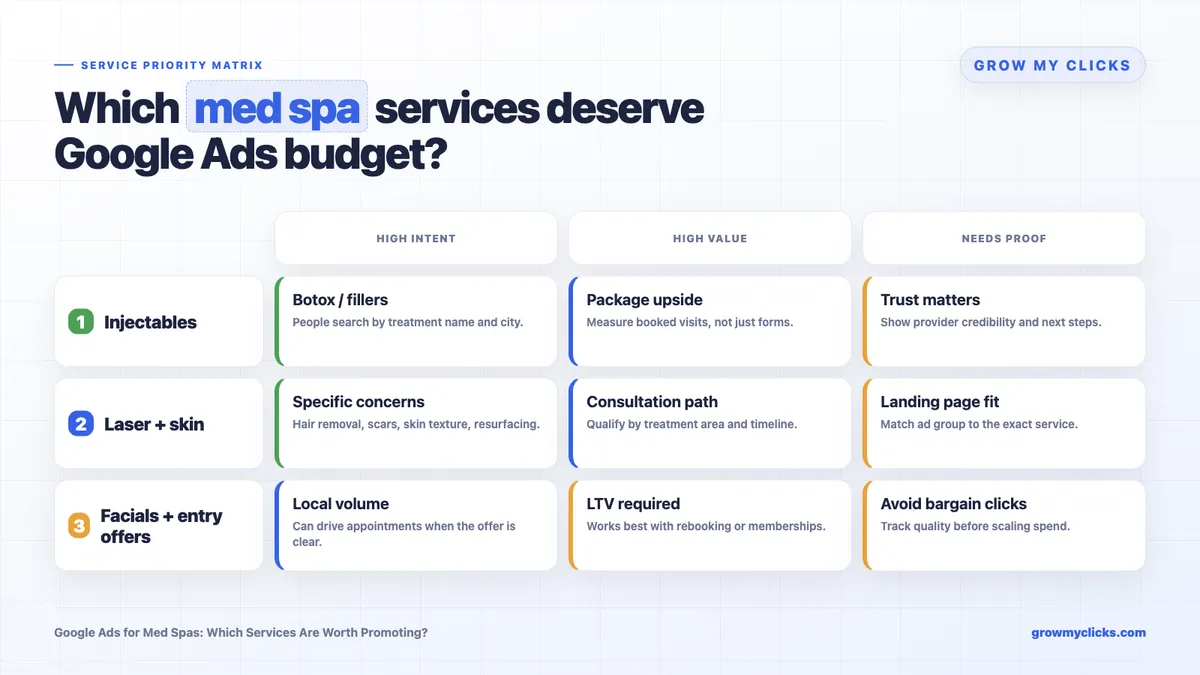
For most med spas, the strongest Google Ads candidates are treatments with three things in common: people know the service name, they search for it locally, and a booked appointment can justify the cost of the click. That is why campaigns often start with services like Botox, dermal fillers, laser hair removal, body contouring, skin resurfacing, or other signature treatments that already have demand in the market.
That does not mean every one of those services should get the same budget. A low-ticket facial, a recurring laser package, and a high-ticket body contouring consultation should be judged differently. The goal is not just more form fills. The goal is more qualified appointments that can turn into profitable treatment plans.
If your med spa is still sending all ad traffic to a generic homepage or a broad “med spa near me” campaign, the first improvement is usually service-level structure: one search intent, one clear landing page, one conversion path, and tracking that shows which service created the booked consultation.
A simple service priority framework for med spa Google Ads
Before choosing a budget, group your services by search intent and appointment value.
High-intent core services
These are the services people commonly search for directly, often with city or “near me” modifiers. Examples include Botox, fillers, laser hair removal, hydrafacial-style treatments, chemical peels, microneedling, and laser skin treatments. These can work well when the ad and landing page match the exact service.
High-value consultation services
Body contouring, weight-loss programs, skin tightening, and advanced laser treatments may have a higher appointment value, but they also need stronger qualification. These campaigns should usually push toward a consultation, not a cheap generic lead form. The page should explain who is a good fit, what happens next, and why the provider is credible.
Entry-level or recurring services
Facials, basic skin treatments, and lower-ticket offers can help introduce new clients to the spa, but the math has to be watched closely. If the first appointment has a lower margin, the campaign needs either strong rebooking, membership, package, or upsell follow-up to make sense.
Education-heavy services
New devices, branded treatments people do not recognize, and vague wellness services may struggle on search if people are not actively looking for them yet. They can still belong in marketing, but Google Search may not be the first place to scale them unless there is already demand.
Services that are often worth testing first
Every market is different, but these categories are usually easier to evaluate because they have clearer search behavior.
- Injectables: Botox, Dysport, Jeuveau, dermal fillers, lip filler, cheek filler, and under-eye filler searches often show direct treatment intent.
- Laser hair removal: Searchers often compare local providers, pricing, packages, and body areas. This can be useful when the spa has a strong offer and follow-up.
- Skin treatments: Microneedling, chemical peels, acne scar treatment, resurfacing, and skin rejuvenation can work when the page speaks to the specific concern.
- Body contouring: Campaigns can justify higher CPCs if the consultation quality and close rate are strong, but weak tracking can make these look better or worse than they really are.
- Facials and Hydrafacial-style services: These can bring local appointment volume, but they should be measured against repeat visits and package revenue, not just the first booking.
When a med spa service is a bad Google Ads candidate
A service may be popular inside the spa but still perform poorly in search campaigns. Watch for these warning signs:
- The service name is unfamiliar, so people are not searching for it directly.
- The treatment has low appointment value and weak repeat-visit follow-up.
- The service requires a long explanation but the landing page is thin.
- The campaign attracts bargain shoppers looking only for the cheapest deal.
- The spa cannot respond quickly to calls, forms, and booking requests.
- Tracking stops at “lead” and never shows which appointments actually showed up or bought.
In those cases, the fix may be a better offer, a better landing page, stronger follow-up, or a different channel. Google Ads should not be forced to carry a service that has no search demand or no clear booking path.
Match the landing page to the treatment
A med spa campaign can have the right keyword and still waste money if the page is too generic. Someone searching for Botox near them should not land on a page that makes them hunt through every service menu item. They need to quickly see the treatment, location, provider trust, appointment options, and next step.
For treatment-specific campaigns, the page should include:
- A headline that matches the treatment and city or service area.
- Clear appointment or consultation CTA.
- Provider credibility, licensing language, reviews, and safety/trust signals.
- Common concerns, candidacy, and what happens at the first visit.
- Phone and form tracking so calls and booked appointments are attributed correctly.
Grow My Clicks builds campaigns around this full path: search intent, service-specific landing page, call/form tracking, CRM follow-up, and booked appointment reporting. See our dedicated page for Google Ads for med spas for the broader campaign approach.
Do not judge services by cost per lead alone
A $40 lead for a low-ticket facial may be worse than a $120 consultation for a treatment package if the second lead books, shows, and buys. Med spa advertising needs to track more than form submissions.
At minimum, review:
- Cost per qualified inquiry by service.
- Call quality and form quality.
- Booked consultation rate.
- Show rate.
- Treatment or package revenue by campaign where possible.
- Repeat appointment or membership follow-up for entry services.
This is also why broader local service campaign lessons still apply. If your account is getting clicks but not appointments, read our guide to Google Ads for local service businesses and our Google Ads management services.
Once you choose a treatment to test, match it to the right next step. Read Booking page or landing page? for a simple decision guide. For campaign help, see Google Ads management for med spas.
Want a clearer med spa ad and booking path?
We can review your treatment campaigns, landing pages, lead handoff, and appointment tracking. You will get a practical list of the gaps to fix first.
FAQ: Google Ads services for med spas
What med spa services usually work best for Google Ads?
Services with strong search intent and clear local demand usually make the best first tests. Botox, fillers, laser hair removal, body contouring consultations, microneedling, chemical peels, and skin treatments can all be good candidates when the landing page and tracking match the service.
Should a med spa advertise every service?
No. It is usually better to start with a smaller number of high-intent or high-value services, prove which ones create booked appointments, and then expand. Advertising every service at once can spread budget too thin and make the data harder to read.
Are facials worth promoting with Google Ads?
Facials can be worth testing if they lead to repeat visits, memberships, packages, or higher-value treatment plans. If the first appointment is low-margin and there is no follow-up system, the campaign may look busy without producing profitable growth.
Why do med spa Google Ads get leads but not booked appointments?
Common causes include broad keywords, weak service-area targeting, generic landing pages, no call tracking, slow follow-up, or campaigns optimized for lead volume instead of appointment quality. The fix is to connect the ad click to the actual booked consultation and treatment revenue where possible.
Where should med spa Google Ads send traffic?
Most treatment campaigns should send traffic to a service-specific landing page, not a generic homepage. The page should match the exact treatment, explain the next step, build trust, and make it easy to call or request an appointment.