
Google Ads for Event Rental Companies
A Google Ads report may show clicks, calls, and forms. An event rental owner still needs to know which inquiries were a good fit, which received a quote, and which became booked events.
That answer usually sits across several places: the ad account, the website, phone calls, quote records, and the team’s follow-up process. The goal is to connect those steps without creating extra work that no one will maintain.
This guide shows a simple tracking path an event rental business can use to make better budget decisions.
The problem with tracking leads instead of booked events
Most event rental campaigns can be made to generate leads. That does not mean the campaign is profitable. A bounce house inquiry outside your delivery area, a wedding tent quote with no date, a price-only table rental question, and a serious corporate event request may all look the same if your reporting only counts form submissions.
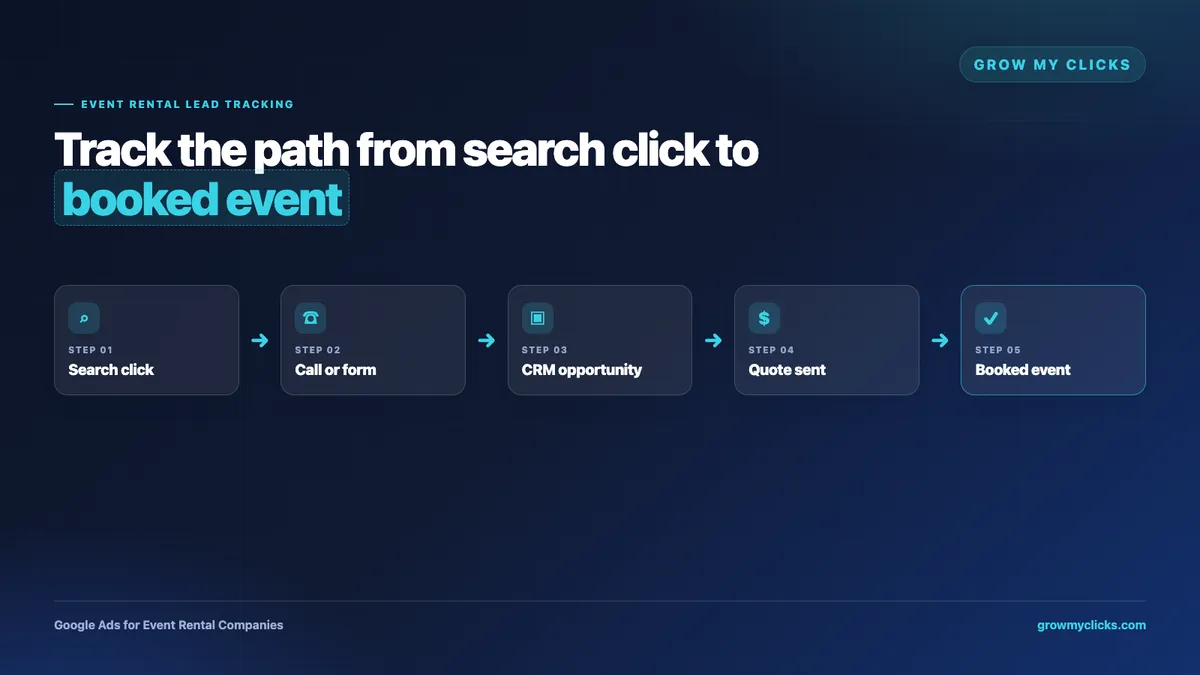
That is why event rental companies need a tracking system that follows the customer path after the initial click. Google Ads should show which campaigns are creating useful inquiries. Your CRM should show which inquiries became quotes, which quotes became booked events, and which booked events created revenue. For the broader search-demand angle, see our related guide on how event service businesses get more bookings from Google.
Grow My Clicks builds event rental campaigns around that complete path: event rental Google Ads, service-specific landing pages, call/form tracking, CRM pipeline stages, and booked-job feedback loops.
What a real tracking path should include
A practical event rental tracking setup does not have to be complicated, but it does need to connect the right systems in the right order.
1. Track the search click and landing page
Start with campaign, ad group, keyword, landing page, and location data. If someone searches for wedding tent rental near me, bounce house rental, chair rental for party, or event rentals near me, that traffic should land on a page that matches the service and service area. Sending every click to a generic homepage makes later reporting harder.
2. Track both calls and forms
Many event rental customers still call, especially when the event date is close or the order is complex. If calls are not tracked alongside forms, Google Ads may look worse than it really is. Use call tracking numbers, form tracking, and source fields so each inquiry can be tied back to the campaign that created it.
3. Push every qualified inquiry into the CRM
The CRM is where a “lead” becomes an actual sales opportunity. At minimum, capture name, phone, email, event date, event type, requested rentals, venue or delivery city, source, landing page, and Google Ads attribution where available.
4. Use pipeline stages that match the sales process
A simple event rental pipeline might include New Lead, Contacted, Quote Needed, Quote Sent, Follow-Up, Booked, Lost, and Unqualified. The exact names matter less than the discipline of moving each opportunity as the conversation changes.
5. Send booked-job data back into reporting
Once an event is booked, the campaign should not be judged only by the original lead. The valuable signal is the booked event, ideally with estimated or actual revenue. Google Ads supports conversion measurement and offline conversion import workflows, including setups that use the Google Click ID when available. The business goal is to teach reporting which clicks became real customers, not just which clicks created activity.
The metrics event rental owners should review every week
If your dashboard only shows clicks, impressions, and cost per lead, it is missing the sales outcome. Review these numbers together:
- Cost per qualified inquiry: How much did you spend for inquiries that match your service area, inventory, and event type?
- Call-to-opportunity rate: How many tracked calls became real opportunities instead of spam, missed calls, or bad-fit questions?
- Quote request rate: Which services create quote-ready conversations?
- Quote sent rate: Are leads getting enough information for the team to price the event?
- Booked-event rate: Which campaigns create revenue, not just forms?
- Booked revenue by source: Which Google Ads campaigns are tied to the strongest event value?
This is where Google Ads for local service businesses and event rental marketing overlap: the ad account is only one part of the system. The landing page, phone handling, quote process, and CRM follow-up decide whether the click becomes money.
Common tracking mistakes in event rental campaigns
Counting every form fill as a win
A lead is not automatically valuable. If the inquiry is outside the delivery radius, too small for the minimum order, missing an event date, or asking for rentals you do not offer, it should be separated from qualified opportunities.
Ignoring phone calls
Phone calls can be some of the highest-intent conversions in event rentals. A customer planning a last-minute party or larger event may call before filling out a form. If those calls are missing from reporting, budget decisions can get distorted.
Using one landing page for every rental type
Tent rentals, bounce houses, tables and chairs, dance floors, concession machines, and full event packages can attract different searches. The more expensive or complex the rental, the more the page needs to answer service-specific questions.
Not tracking the quote stage
If many leads never receive a quote, the ad campaign may not be the only problem. The issue could be slow response time, missing event details, unclear pricing, weak follow-up, or an overloaded office process.
Optimizing Google Ads for cheap leads
Cheap leads can be expensive if they never book. A campaign with a higher cost per lead may be better if those leads request larger tents, full party packages, weddings, corporate events, or repeat seasonal rentals.
A simple booked-job tracking blueprint
Here is the practical structure we would want in place before scaling event rental ad spend:
- Use service-specific campaigns or ad groups for the highest-value rental categories.
- Send traffic to matching landing pages with clear phone and quote-request CTAs.
- Track calls, forms, source, landing page, and service requested.
- Create a CRM opportunity for each qualified inquiry.
- Move opportunities through quote and follow-up stages.
- Mark booked events clearly and attach estimated or final revenue when possible.
- Review campaign performance by booked events, not just lead count.
If tent rentals are one of your main revenue drivers, pair this with our guide to Google Ads for tent rental companies and the related post on tent rental Google Ads lead generation.
How this changes budget decisions
Once booked-job tracking is in place, budget allocation becomes easier. You may find that broad “event rentals” traffic creates many small questions, while tent or wedding rental searches create fewer but better opportunities. You may find that a certain city spends a lot but rarely books because it is too far from your delivery base. You may also find that some calls are valuable but never counted inside the old form-only setup.
The point is not to make reporting prettier. The point is to stop making budget decisions from incomplete data. For event rental businesses, the best campaigns usually win because the whole path is measured: search intent, page match, response speed, quote quality, follow-up, and booked event value.
Want to know which Google Ads leads are becoming booked events?
Grow My Clicks can review your Google Ads account, landing pages, call/form tracking, and CRM pipeline to find where event rental leads are turning into booked jobs — and where the budget is leaking.
Book a free Google Ads audit and we’ll help you judge the account by real opportunities, not vanity lead volume. You can also review our Google Ads management services to see how we structure campaigns, tracking, and follow-up.
FAQ: Event rental Google Ads tracking
What should an event rental company count as a Google Ads conversion?
Track the first inquiry, but do not stop there. Calls and forms are useful micro-conversions, while qualified quote requests and booked events are the stronger business outcomes to review when deciding budget.
Should event rental companies track phone calls from Google Ads?
Yes. Many event rental customers call when they have a date, venue, inventory question, or urgent request. If phone calls are not tracked, the campaign may be undervalued or optimized toward lower-intent form fills.
How do I know which campaign created a booked event?
Use landing page tracking, source fields, call tracking, form tracking, and CRM opportunity stages. When possible, preserve Google Ads attribution such as the click ID so later booked-event data can be connected back to the original campaign.
Why do Google Ads leads not always turn into booked events?
Common reasons include broad keywords, wrong service areas, low-intent searches, weak landing pages, missed calls, slow quote follow-up, missing event details, or no process for moving opportunities through the pipeline.
What is the best landing page for event rental ads?
The best page matches the search intent. A tent rental campaign should usually go to a tent rental page, while a broader event rental campaign should clearly explain services, delivery areas, quote requirements, and the next step to call or request pricing.